Why Pharmacy Delivery Is Different From Standard Courier Work
If you run a community pharmacy in the UK, chances are your delivery operation has grown faster than the systems managing it.
A few years ago, a driver with a list and a bag full of prescriptions was enough to manage deliveries. Today, patients expect to know exactly when their medication will arrive. NHS processes are digital. Regulators want documentation. And your competitors, including online-only pharmacies, are offering tracking, notifications, and next-day delivery as standard.
This guide breaks down what delivery management software actually does for pharmacies, why generic courier tools fall short, and what to look for if you are ready to bring your pharmacy's delivery operation up to speed.
It is easy to assume that any delivery tracking tool would do the job. Route planning is route planning, right?
Not quite.
When a restaurant delivers a takeaway and the driver knocks on the wrong door, it is an inconvenience. When a pharmacy driver delivers the wrong prescription, or leaves a controlled drug at an unattended address, the consequences are far more serious. That is the fundamental difference.
Pharmacy delivery involves patient-identifiable data, regulated medicines, time-critical repeat prescriptions, and, in some cases, items that require a signature upon receipt. Managing all of that through spreadsheets, WhatsApp messages to your driver, and handwritten logs creates risk, both clinical and regulatory.
This is exactly why purpose-built delivery management software for pharmacies exists, and why the sector is increasingly adopting it.
What Delivery Management Software Actually Does
At its core, delivery management software gives your pharmacy a single system to manage everything from the moment a prescription is bagged and labelled to the moment it reaches the patient's door.
The key functions that matter specifically for UK pharmacies include:
Route optimisation
This is the feature that saves the most time and money in practice. Rather than your driver working from a handwritten list or plotting their own route, the software automatically groups deliveries by location and calculates the most efficient order. For a pharmacy making 20 to 50 deliveries a day across a town or borough, the fuel savings and time gains are significant.
Modern route optimisation tools also account for real-world factors such as traffic conditions, delivery time windows, and driver start and end points, rather than simply drawing a straight line between stops. The result is fewer miles driven, fewer missed deliveries, and a driver who finishes their round on time rather than two hours late.
NHS and EPS integration
This is where pharmacy-specific software earns its place. The NHS Electronic Prescription Service now handles over 95% of prescriptions in England electronically. When your delivery management system integrates with your dispensary workflow, prescriptions flow from dispensing into the delivery queue without manual re-entry.
That matters because re-keying patient data between systems is where errors happen. It also creates delays. A properly integrated system means that once a prescription is dispensed and bagged, it can be assigned to a delivery run in seconds, with the patient's address already populated and verified.
For pharmacies operating under the NHS Terms of Service and managing Pharmacy First consultations, having a connected digital workflow also makes it considerably easier to demonstrate that services are being delivered safely and in line with contractual requirements.
Digital proof of delivery
Paper delivery logs are still common in independent pharmacies, but they present a real problem. They can be lost, illegible, or disputed. When a patient or their family contacts the pharmacy to say a delivery never arrived, a handwritten note with an unclear signature is not a strong defence.
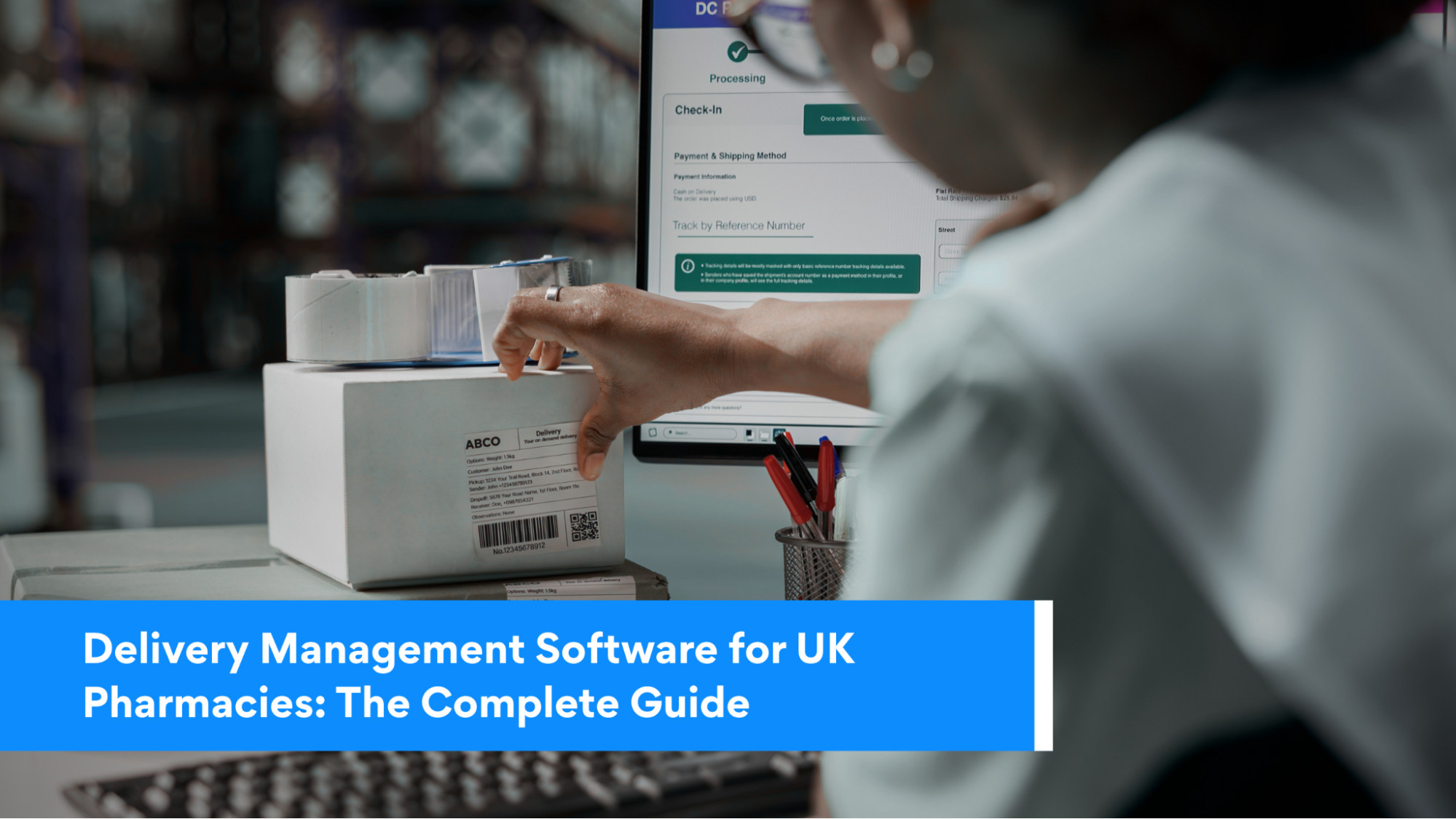
Digital proof of delivery captures a time-stamped photograph or electronic signature at the point of handover, tied to a specific patient record. That log is stored automatically, is searchable, and available if needed for a GPhC inspection or a complaint investigation.
For controlled drugs, where documentation requirements are particularly strict, this kind of audit trail is not optional. It is part of operating safely.
Real-time tracking and patient notifications
Patients have come to expect the same visibility from their pharmacy that they get from a parcel courier. Knowing when a delivery is ten minutes away matters, especially to elderly patients, those with mobility difficulties, or anyone who needs to arrange to be home.
Automated SMS or email notifications, triggered when a driver is approaching, significantly reduce failed deliveries. Fewer failed deliveries mean fewer redelivery attempts, less driver time wasted, and fewer frustrated patients calling the pharmacy to ask where their medication is.
The Real Cost of Getting Delivery Wrong
It is worth being direct about this.
A missed delivery is not just an inconvenience. For a patient managing a long-term condition, running out of medication because a delivery failed can have real clinical consequences. For the pharmacy, a pattern of failed or late deliveries damages the reputation that has probably taken years to build.
There is also a regulatory dimension. The GPhC expects registered pharmacies to demonstrate that their services, including home delivery, are being managed safely. That includes having systems in place to document handovers, protect patient data in transit, and manage any incidents where deliveries go wrong.
Software does not remove the need for professional judgement. But it does provide the structure and documentation that make it far easier to demonstrate safe, accountable practice.
What to Look for in Delivery Management Software for Your Pharmacy
Not all platforms are built with UK community pharmacies in mind. When evaluating options, these are the areas worth examining closely.
Dispensary system compatibility
The software needs to connect with how your pharmacy already works. If your delivery management tool requires your team to manually transfer information from your PMR system into a separate platform, you have not solved the problem. You have just moved it.
Look for software that integrates with your existing dispensing workflow, whether that is through a direct API connection or a verified partnership with your PMR provider.
GDPR-compliant data handling
Patient delivery data, including names, addresses, and medication details, is sensitive personal information under UK GDPR. Check how any software provider stores, processes, and protects that data. Servers should be UK or EEA-based, data should be encrypted in transit and at rest, and the provider should be able to clearly explain their data processing arrangements.
Scalability
A small pharmacy making 15 deliveries a day has different needs from a large independent or a small chain covering multiple sites. The platform you choose should be able to grow with your delivery volume without requiring a complete system change. Multi-branch management from a single dashboard is particularly valuable if you operate more than one premises.
Driver app usability
Your drivers need to be able to use the system confidently. A complex app with a steep learning curve will create resistance and inefficiencies. The best pharmacy delivery apps are straightforward. The driver can see their route, navigate to each stop, capture a signature or photograph, and mark a delivery complete without needing to remember multiple steps.
How Pharmace Digital Approaches Delivery Management
Pharmace Digital has been built specifically for UK community pharmacies. That means the delivery management module works within a broader platform that already covers prescription filing, compliance records, and operational management, rather than a standalone tool requiring manual integration.
Route optimisation is built in, designed around the kind of delivery volumes and geographic coverage that community pharmacies actually deal with. Proof of delivery is captured digitally and stored against patient records automatically. And because the platform is designed with NHS workflows in mind, delivery management sits alongside your EPS integration rather than operating separately from it.
For pharmacy owners who are trying to reduce admin, tighten up compliance documentation, and offer patients a more reliable delivery experience, having all of this in one place makes a tangible difference day to day. View Pharmace Digital pricing to see which plan fits your pharmacy.
Is Now the Right Time to Switch?
If your current delivery process relies heavily on manual steps such as paper logs, WhatsApp coordination with drivers, or spreadsheets to track what has and has not been delivered, then the honest answer is probably yes.
The volume of pharmacy home deliveries in the UK has grown substantially over the past few years, and that trend is continuing. Patients who started using home delivery during the pandemic have largely kept that habit. Online pharmacy operators have raised expectations across the board.
The pharmacies that will compete most effectively are those that can offer reliable, trackable, documented delivery as a standard part of their service, not as an occasional favour to a few regular patients.
Delivery management software is not a luxury addition. For a growing number of UK pharmacies, it is becoming a basic operational requirement.